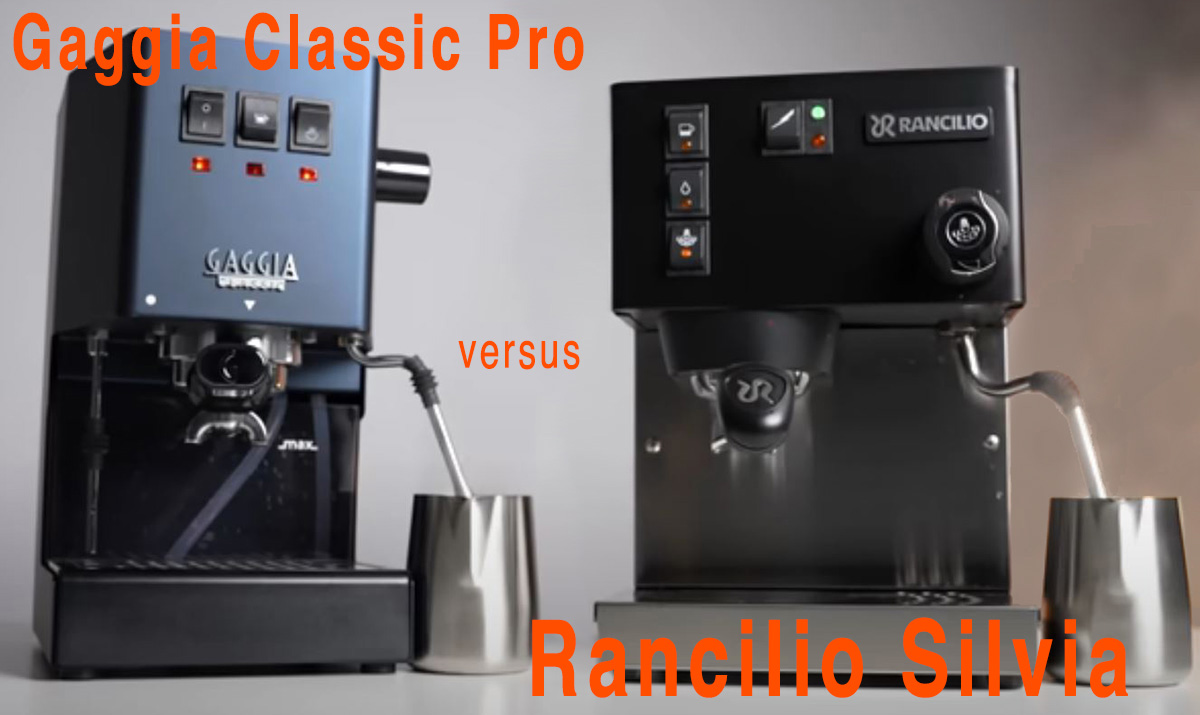
If you are searching for a mid-range semi-automatic espresso machine for your morning coffee fix, there are many options. However, the Gaggia Classic and Rancilio Silvia are frequently compared. While other machines exist in the same price range, these two Italian espresso machines consistently earn the highest customer ratings for build quality and shot consistency.
This expert comparison examines the Rancilio Silvia versus the Gaggia Classic Pro, two iconic Italian espresso machines. The battle between the Silvia at $800 and the Classic at $450 often appears to come down to budget. However, for those with the means, the Rancilio machine delivers superior thermal stability and durability. We have a detailed review of the Silvia, where we explain in depth why it remains a benchmark in the home espresso community.
When comparing the Gaggia Classic Pro to the Rancilio Silvia, the Classic Pro excels in several aspects, including steam wand performance and value. However, the Silvia’s larger brass boiler and commercial-grade components ultimately make it the winner for serious home baristas seeking temperature stability.
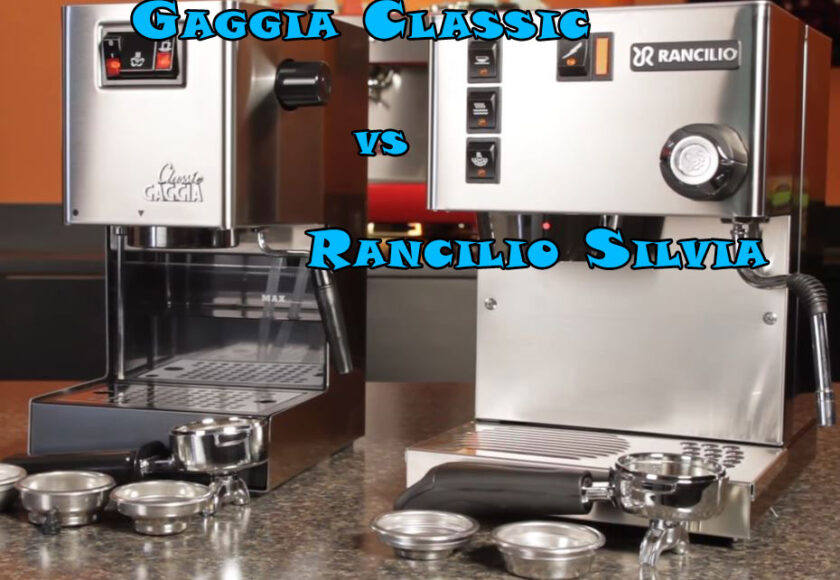
Rancilio Silvia vs Gaggia Classic – Side by Side Comparison
The comparison is by no means a fair one. We are comparing an $800 machine with a $450 one. I’ve seen manufacturers trying to make a quick buck by over-pricing equipment, but this is not the case with Rancilio. However, to clarify why the Silvia commands a higher price, here is an expert breakdown of the key differences.
While price wise Gaggia Classic Pro is the clear winner, there are specific technical areas where the Gaggia falls short. Rancilio Silvia features a significantly larger boiler (300ml vs. 120ml), enabling superior thermal stability and the ability to pull consecutive shots without extended recovery time.
The larger boiler also provides a distinct advantage for milk-based drinks, as the increased steam volume allows for more consistent and powerful microfoam production when steaming multiple lattes or cappuccinos in a row.
Surprisingly, the Gaggia Classic Pro heats up faster, partly due to its more powerful 1200W heating element, but also because of its smaller boiler—a trade-off that negatively impacts thermal stability during back-to-back extractions.
Both machines are equipped with a 3-way solenoid valve for pressure release. They also share commercial-grade, chrome-plated brass portafilters and commercial-style steam wands, which are essential for precise milk texturing.
The commercial-style steam wand is ideal for baristas seeking manual control over milk texturing. However, if you prefer a simpler method for making a cappuccino, a panarello attachment is available for either machine. For latte and flat white preparation, the stock steaming tip offers superior results, though it requires practice to master the technique.
The Silvia is overall more robust, featuring a heavy-duty steel frame that adds significant weight, reduces operational vibrations, and ensures long-term durability for daily use.
I personally don’t prefer pressurized baskets, but they can help absolute beginners achieve decent shots. The Gaggia includes two sets of baskets: one non-pressurized for precision and one pressurized for convenience.
The portafilter is a 58 mm chrome-plated brass commercial unit. As an espresso enthusiast, I appreciate wide portafilters for their even extraction, and brass is the optimal material due to its superior thermal conductivity and heat retention.
For those planning to place the machine under low cabinets, the Gaggia Classic is ideal. Its water reservoir is accessible from both the top of the machine and the front (by removing the drip tray), offering flexible placement options.
The Silvia’s group head is constructed from brass for superior thermal stability, while the Classic Pro’s group head is made from steel, which is less effective at maintaining consistent brewing temperatures.
Here is a side-by-side comparison of the Rancilio Silvia vs Gaggia Classic:
| Gaggia Classic Pro | Rancilio Silvia M | |
| Price | $450 – Winner | $800 |
| Aesthetics and Design | tie | tie |
| Water Tank | 2.1 liter | 2 Liter |
| Water tank access | Access from the top and front | Access from the top |
| Boiler capacity | 3.5 oz. | 10 oz. |
| Boiler material | aluminum | brass |
| Boiler Heating Element | 1370W | 800W |
| Initial Heat Up | 65 sec | 190 sec |
| Temperature stability | tie | tie |
| Steam wand | commercial style | commercial style |
| Time to produce steam | 28 sec | 20 sec |
| 3-way Solenoid Valve | yes | yes |
| Robustness and reliability | reliable but Silvia lasts longer | Reliable |
| Filter basket | 2 sets of single and double baskets | 1 set of single and double baskets |
| Portafilter | 58 mm chrome plated bras | 58 mm chrome plated bras |
| Grouphead | steel | brass |
| Pressure | 9 bars of pressure | 9 bars of pressure |
| Pump | 15 bars with over pressure valve | 15 bars with over pressure valve |
| Other | stainless steel housing | stainless steel housing |
| Controls | sturdy rock-switch controls | sturdy rock-switch controls |
| Weight | 20lbs | 30lbs |
Yes, there is a notable price difference between the two. Some consider that difference the deciding factor. However, consider that you will be pulling numerous perfect espresso shots with this machine. Your comfort and the machine’s long-term performance should guide your decision.
Rancilio Silvia
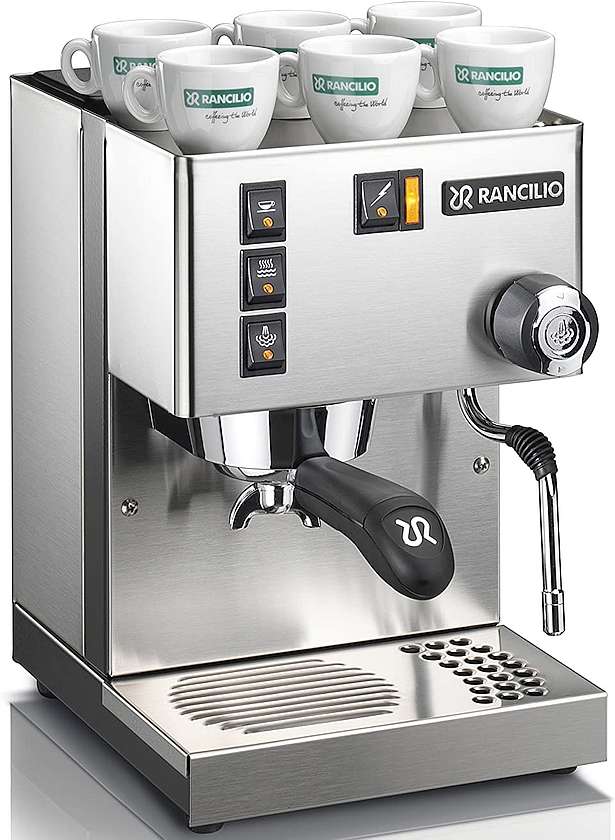
With a sturdy stainless steel casing and brass components, Rancilio Silvia is one of the most popular machines on the market. Simple, powerful and reliable, Rancilio Silvia espresso machines have been the choice of many home baristas for a long time. These machines simply don’t die. We have a full review of the Rancilio Silvia here.
Pros
- Rancilio Silvia is one of the most reliable semiautomatic espresso machines for home use.
- It has a large boiler, which allows you to pull more than two shots at a time.
- Milk-based drinks are easier to make, grace to the large boiler. The boiler creates decent pressure, and allows more milk steaming or frothing back to back.
- Silvia looks stunning in any kitchen; the minimalist design, with stainless steel side panels, is just great.
- The iron frame gives the machine stability and reduces the vibrations.
Cons
- It is a bit “temperamental”, the brewing temperature can fluctuate quite consistently, and that’s going to affect your shot.
- Single boiler, dual use, however, because the boiler is so big is less of a problem than with Gaggia.
Conclusion
The reliability and sturdiness of this machine make it unique. The decision to not include a PID might be seen as a bad decision, and many espresso enthusiasts critique it. However it is this simplicity that makes the machine so reliable.
The portafilter and the 58mm filter basket amazing. You can also buy an aftermarket naked portafilter for you Silvia, but this is later on, when you would have perfected your technique.
Gaggia Classic Pro Espresso Machine
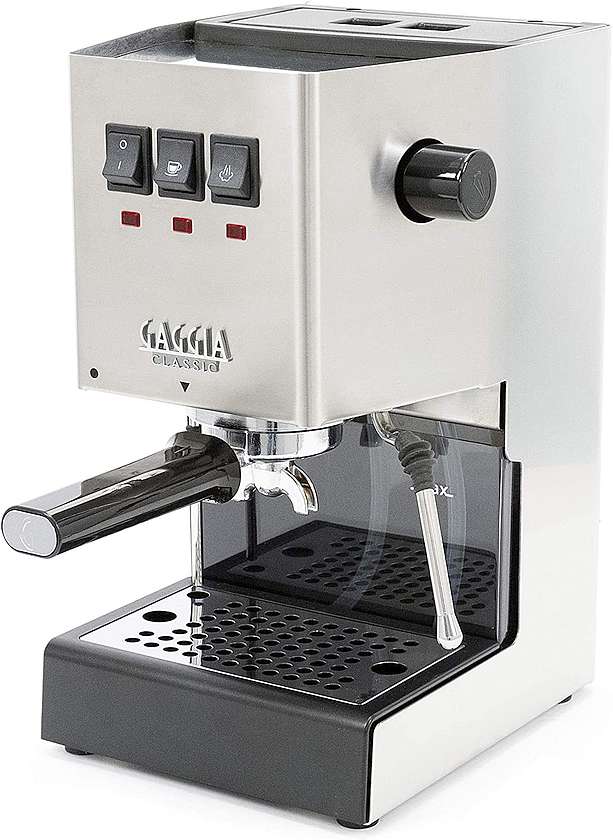
The Gaggia Classic Pro is the best entry espresso machine. Gaggia Classic has been around for a long, time and is got some fixes to address some of the feedback on the market. If this is your target price range, you can’t go wrong with it.
Pros
- It is very elegant, and it fits in any modern kitchen easily.
- Can be used with ESE pods.
- It comes with a pressurized portafilter, which will help you pull nice looking shots.
- It is very affordable, compared to Rancilio is about 75% less expensive
- The semi-automatics from Gaggia are insanely reliable.
- The powerful heating element allows fast reheating after use, which offsets a little Silvia’s advantage of having a large brass boiler.
Cons
- The milk frother is not that good, many people just change it with a Rancilio frother.
- The boiler is small, that means more waiting between pulling shots, and less steaming power for milke based beverages.
- Single boiler dual use, but this is normal for this price range.
- As with Silvia, temperature surfing is needed.
- The boiler is a bit smaller than the Silvia’s and that makes the Classic ideal for day to day espresso pulling, but it’s not ideal if you have guests.
Conclusion and other Options
A big problem with both of these machines, and any other similar machine for that matter, is the brewing temperature stability. The brewing thermostat will engage and disengage at the set temperature, but the heating element is already hot and it will heat the water in the boiler for longer. It’s because of thermal inertia.
The brewing temperature can be consistently higher than the ideal espresso extraction temperature. This will lead to over-extracted, or under-extracted coffee.
Some Silvia and Classic Pro owners modified their machines to include a PID, in order to improve the temperature control. Others, prefer to stick to simplicity, and a technique called “temperature surfing” when pulling shot. The technique is very popular among Silvia and Gaggia owners.
If you have the budget, buy the Silvia, you won’t have to wait between shots, or texturing milk for espresso and milk beverages. But if your budget is tight, and you only make one or two shots, the Classic Pro is perfect.
But if you only need one or two drinks every morning, buy the Gaggia Classic Pro, as you will save a few hundred dollars.
The pressurized baskets might seem like a deal, however, I strongly suggest you to avoid them. The pressurized baskets will allow you to use pre-ground coffee with your machine, but coffee made with these is not as good. The non-pressurized filter baskets pull far better shots, if you master the technique. The ESE pods are a nice touch, although I don’t care much about this feature for a semi-automatic.
The temperature surfing is annoying, but it’s something you get used to after using the machine for a while. Both of the machine have this problem because they don’t have a PID. If you think that temperature surfing is not a big deal, then Silvia and the Classic pro are the best choices within this price range. If you hate temperature surfing, you wouldn’t be the only one. If you need an espresso machine guide, take a look at our cheap PID espresso machine recommendations, the budget to get one of those is the same. Though win some, lose some. What you win in features, you might lose in durability, or material quality.
| Rancilio Silvia | Gaggia RI9380/46 Classic Pro | |
| Amazon | Check Price | Check Price |
| Whole Latte Love | Check Price | Check Price |
| Prima Coffee | Check Price |
Some of the alternatives are the Breville Barista Express, Breville Bambino, Lelit Ana, or the Ascaso Dream. Some of these alternatives come with a PID and a pressure gauge, which you only get with prosumer machines.
The filter baskets are 58mm which is great for pulling great shots. In my experience, the narrower the baskets, the harder to find the perfect grind size.
When you plan the budget, make sure you plan for a burr coffee grinder as well, if you don’t already own one. As I mentioned before, using pre-ground is not the best. Always buy whole coffee beans and grind just before brewing.
In an economy where everything is made to last as little as possible, you wonder how come Gaggia and Rancilio didn’t change yet.